
PVC Labels Consistently Undercured & Yellowing? Choosing the Right Oven Trays & PVC Ovens Outperforms Dozens of Process Trials
Root Causes of the Two Major Defects
(1) Undercuring (Sticky Surface, Difficult Demolding, Deformation, Whitening After Washing)
Core triggers: insufficient temperature, uneven heat distribution, inadequate baking time, poor thermal conductivity of molds, or imbalanced PVC paste formulation.
(2) Yellowing (Overall Discoloration, Burnt Edges, Post-production Yellowing During Storage)
Core triggers: localized overheating, severe temperature deviation inside the oven, low-performance oven trays, inferior stabilizers, excessive baking duration, or poor ventilation.
Most manufacturers only tweak temperature and time parameters while ignoring oven and tray hardware. Repeated process testing will never fully resolve defects without matching suitable equipment.
(Intelligent Pvc Oven,Intelligent Pvc Baking Machine,Energy-Saving Pvc Oven, Silicone Oven, PVC oven, Intelligent Silicone Oven)
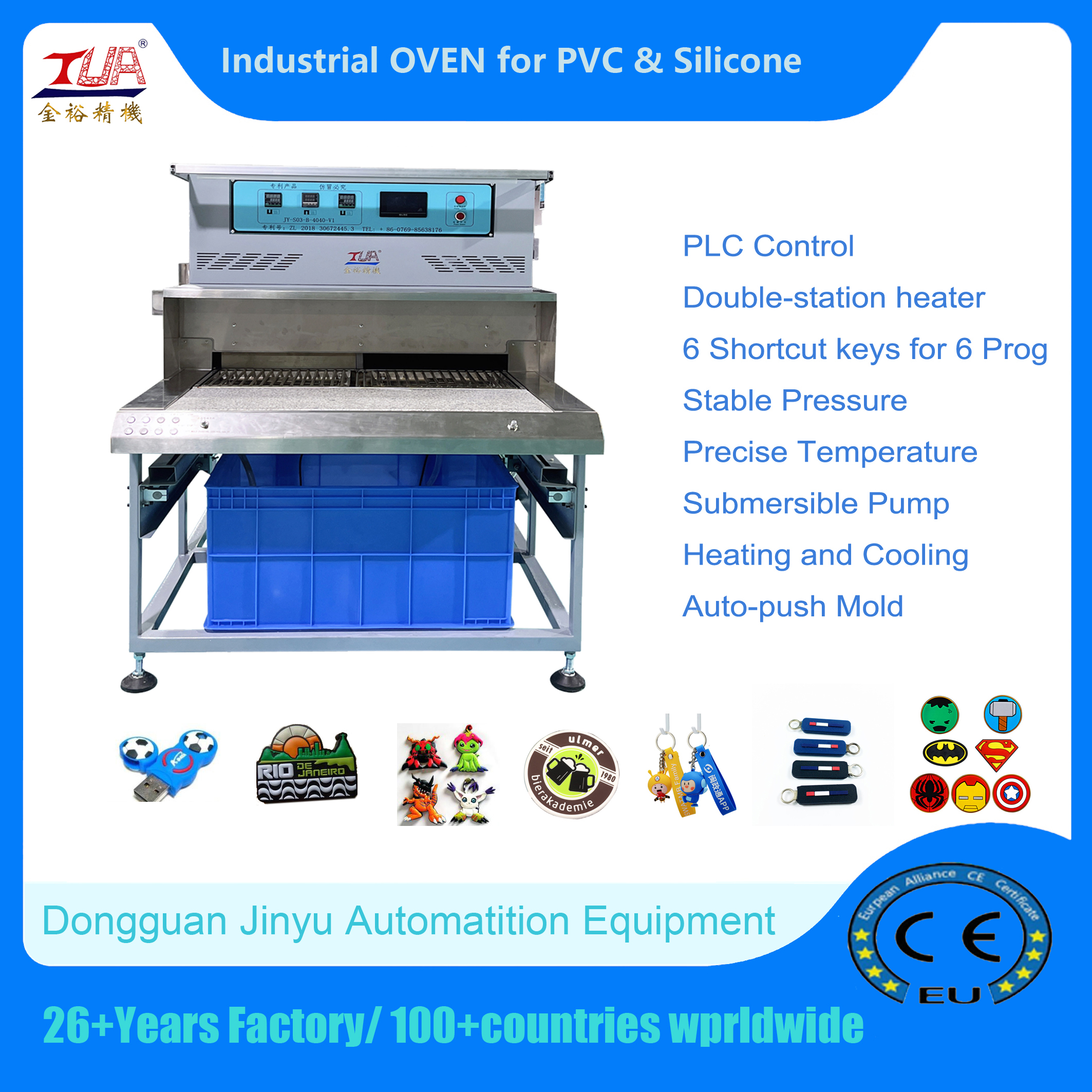
Oven Selection & Comparison: Oven Type Greatly Impacts Finished PVC Label Quality
1. Small Electric Drying Ovens (Simple Industrial / Household Models)
Drawbacks:
Internal temperature deviation ranges ±15~30°C. Cool corners cause undercuring while hot central areas lead to yellowing.
No forced hot air circulation. Stacked molds trap heat at the bottom, resulting in sticky undersides and yellow surfaces.
No segmented temperature control. Sharp temperature spikes form a cured outer skin while inner material remains uncured.
Application: Prototyping and tiny batch production only; unsuitable for mass manufacturing.
2. Industrial Hot Air Circulation Ovens (Recommended Dedicated Model for PVC Labels)
Advantages:
Forced upper & lower hot air circulation limits internal temperature deviation within ±3°C, delivering even heating across all trays to eliminate partial undercuring and burnt edges.
Supports segmented temperature control: low-temperature leveling → medium-temperature curing → constant-temperature maturation, perfectly matching PVC dispensing workflows.
Bottom exhaust vents promptly discharge volatilized plasticizers to prevent oil residue buildup and yellowing.
Mandatory purchasing criteria:
Dual-channel circulating fans with independent air ducts per layer
Digital temperature controller with timer and overtemperature alarm
Breathable partition boards for each layer to avoid heat trapping inside closed molds
3. Continuous Tunnel Ovens (For High-volume Automated Production Lines)
Equipped with three independent temperature zones:
Zone 1 (Low-temp Leveling): 80–100°C
Zone 2 (Main Curing): 160–180°C
Zone 3 (Constant-temperature Maturation)
Key mitigation: Poor thermal conductivity conveyor belts cause bottom undercuring. Pair with aluminum oven trays, and adjustable air velocity to avoid surface scorching while interior material stays uncured.

Oven Tray Selection: Resolves 80% of Undercuring & Yellowing Issues
1. Solid Aluminum Trays (Top Choice for PVC Labels)
Advantages: Fast, uniform heat absorption and steady heat dissipation. Molds heat evenly top and bottom to prevent inconsistent curing.
Recommended specification: ≥3mm thick solid polished aluminum sheets to avoid oxide stains contaminating labels.
Operation tip: Fully cover each oven shelf with aluminum trays; avoid large hollow gaps between molds to minimize temperature fluctuations.
2. Thin Iron Trays (Low-cost Defective Option)
Critical flaws: Slow heat absorption and weak heat retention. Mold edges lack sufficient heat and remain undercured, while thin metal sections overheat and turn edges yellow. Thin iron also warps at high temperatures, causing paste overflow from tilted molds.
Only for temporary prototyping; discard for mass production.
3. Stainless Steel Trays
Lower thermal conductivity than aluminum, requiring 20% longer baking time at identical set temperatures, which frequently leads to incomplete internal curing. Suitable only for high-hardness PVC, not standard soft colored labels.
4. Aluminum Frame with Silicone Pad Combos (For Mini Thin Labels & 3D Logos)
Designed for slim miniature labels. The silicone buffer layer prevents direct extreme high-temperature scorching at the base, balancing heat transfer to fix dual issues: burnt thin edges and undercured large flat surfaces.
Standard Baking Process After Proper Equipment Matching (Universal for Soft PVC Labels)
Flat PVC Labels (1.5–3mm Thickness)
Leveling Stage: 90–110°C, 5–8 mins
Function: Enable paste self-leveling and release air bubbles. Skipping this step creates a sealed outer skin trapping air bubbles, leading to permanent undercuring.
Main Curing Stage: 170–175°C, 12–18 mins (Hot air circulation oven)
Non-circulation simple ovens: Set to 180–185°C, extend bake time to 22–28 mins. Wide temperature deviation forces higher heat and longer time, drastically raising yellowing risk.
Final Maturation Hold: 140°C, 3 mins
Fully decomposes excess plasticizers to eliminate post-bake stickiness and long-term storage yellowing.
Thick / Multi-layer 3D PVC Labels (3–6mm Thickness)
Reduce main curing temp


