

Silicone Product Manufacturing: Solid HCR vs Liquid LSR vs Combined Solid-Liquid Molding
I. Basic Material & Process Overview
1. Solid Silicone Rubber (HCR – Hot Cured Rubber, Compression Molding, Traditional Process)
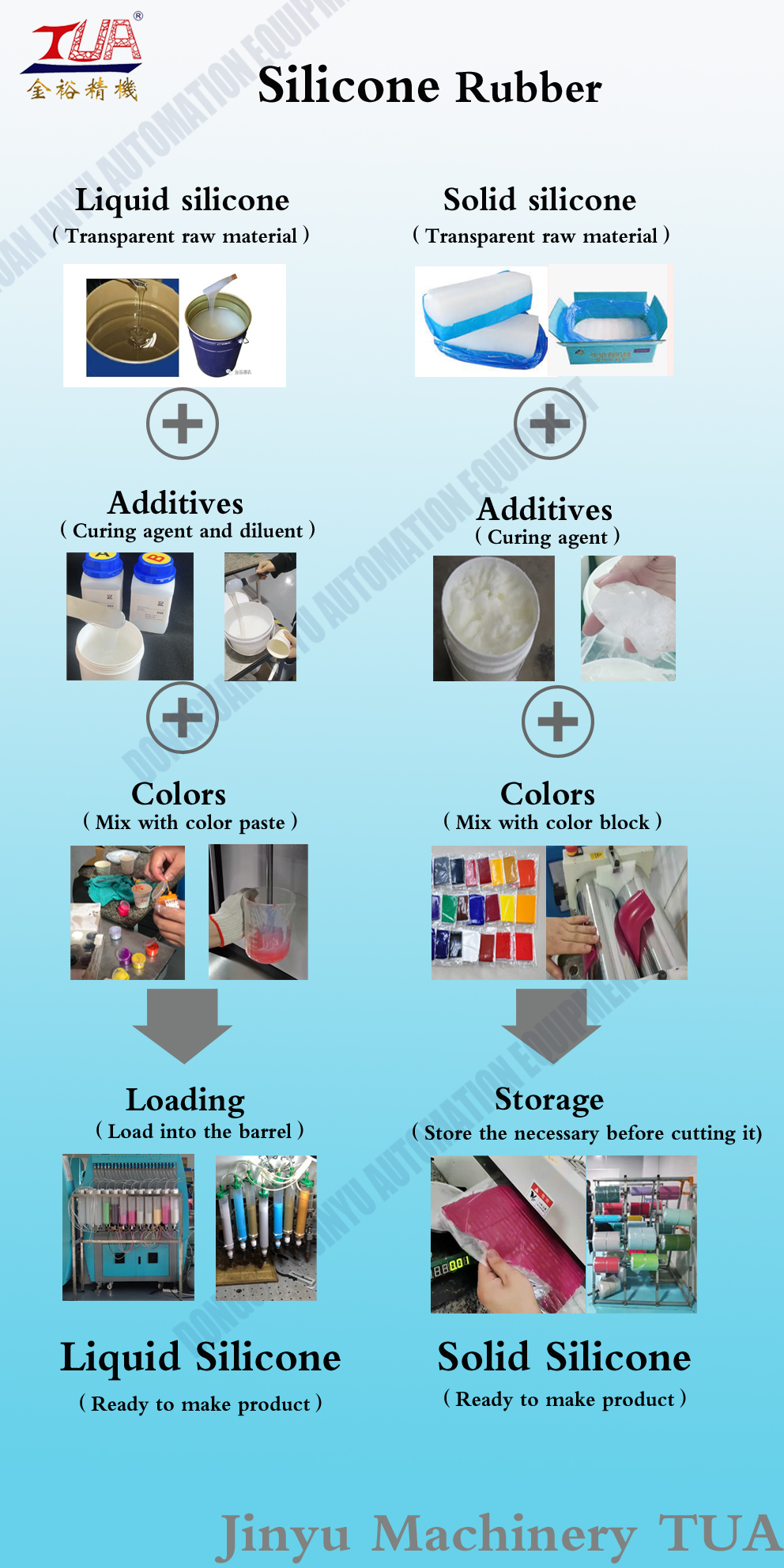
Raw Material Form
Solid rubber blocks/sheets at room temperature. Manufacturers need to internally mix the base rubber with curing agents, color masterbatches, and reinforcing powders to customize hardness, color, wear resistance, flame retardancy and other formulas.
Full Production Flow
Mixing: Blend raw rubber, curing agent, color powder and additives via internal mixer, then extrude into sheets.
Cutting & Weighing: Manually cut rubber blanks according to product weight.
Loading into Mold: Open the mold and lay rubber blanks inside cavities.
Mold Closing & Curing: Heat to 150–200°C under 5–10 MPa pressure; cure for 2–10 minutes.
Mold Opening & Ejection, Trimming flashing (excess burrs are heavy).
Optional Secondary Post-Curing in oven (remove small molecules and odors).
Core Process Features
Open-mold filling: Load raw material after mold opening, then close and compress to let rubber flow and fill cavities.
Crosslinking: Mostly peroxide curing, which easily leaves residual small molecules and causes strong odor; platinum-cured solid silicone is available for premium grades.
Equipment: Standard hydraulic compression press with low initial investment (USD 3,000–8,000 per unit); simple low-cost molds with fast tooling turnaround.
High labor dependency: Cutting, loading and trimming all require manual work; one operator can only monitor 1–2 machines.
Pros
Low upfront cost, cost-effective for small batches and prototype sampling.
Suitable for extra-large and thick-walled parts (silicone mats, large sealing gaskets, thick silicone kitchenware).
Highly flexible formula modification for high tensile strength, wear resistance, flame retardancy, conductivity and other special properties.
Low cost for mold revisions and frequent design changes.
Cons
Long cycle time; labor costs surge for mass production.
Low dimensional accuracy with tolerance ±0.1~0.3 mm, thick parting lines and heavy post-trimming workload.
Open production environment prone to dust contamination, hard to meet cleanliness standards for food/medical applications.
Peroxide-cured parts carry odor and low transparency; thin-walled intricate structures easily suffer incomplete filling and air bubbles.
Typical Applications
Ordinary silicone keypads, industrial large sealing rings, silicone anti-slip mats, thick silicone cookware, general automotive silicone parts, small-batch custom products, conductive/flame-retardant specialty silicone components.
2. Liquid Silicone Rubber (LSR – Liquid Silicone Rubber, LIM Liquid Injection Molding, High-Precision Automated Process)
Raw Material Form
Two-part liquid system (Part A : Part B = 1:1 pre-mixed with platinum catalyst). No in-house mixing required; ready to load directly onto production machines. Food/medical grades feature ultra-pure raw materials free of impurities.
Full Production Flow
Sealed raw material barrels connect to LSR injection machines; equipment automatically meters, mixes Part A and Part B via static mixer.
Closed-mold injection: Fully close the mold first, then inject liquid silicone under high pressure through cold runner into heated cavities.
Fast high-temperature curing: 160–190°C, cure time only 10–60 seconds.
Automatic mold opening and ejection with minimal flashing; light trimming only, secondary post-curing unnecessary for most cases.
Core Process Features
Closed injection system: Fully sealed pipelines and cavities with zero air exposure, supporting cleanroom manufacturing for medical products.
Crosslinking: Platinum addition curing with no volatile small molecules, odor-free, high transparency and anti-yellowing performance.
Equipment: Specialized LSR injection molding machines (USD 7,500–15,000 per unit); hot runner molds cost 2–3 times solid silicone compression molds.
High automation: Automatic batching, injection and ejection; one operator can manage 8–10 machines simultaneously.
Pros
Ultra-fast molding cycle, lower unit cost for mass volume production.
Ultra-high precision with tolerance ±0.01~0.05 mm; effortlessly fills thin-walled, micro-sized, textured and deep-groove complex structures.
Minimal burrs, smooth high-transparency surface with skin-friendly soft touch, ideal for medical, infant and wearable consumer goods.
Overmolding capability: Directly inject silicone over plastic or metal inserts with strong adhesion and no delamination, achieving IP67/IP68 waterproof sealing.
Closed production avoids contamination; easily passes FDA, LFGB and ISO 10993 biocompatibility certifications.
Cons
Huge upfront investment on equipment and molds; expensive sampling and small-batch production.
Poor heat dissipation for thick-walled parts, prone to internal bubbling; not recommended for extra-thick and oversized products.
Higher raw material unit price; fewer modified specialty formulas (conductive, ultra-wear-resistant) compared to solid silicone.
Typical Applications
Baby nipples, silicone food utensils, medical catheters & seals, waterproof gaskets for smartwatches/earphones, precision keypads, ultra-thin protective films, plastic/metal integrated overmolded parts, optical transparent silicone components.
II. Combined Solid & Liquid Silicone Molding (Dual-Process Composite Molding)
Three mainstream composite solutions:
Solution 1: Solid Silicone Substrate + Secondary LSR Overmolding (Most Widely Used)
Process:
Fabricate thick structural base via solid compression molding (for structural support and cost control of large-volume parts).
Place pre-molded solid silicone semi-finished parts into LSR injection molds, activate surface adhesion via primer treatment.
Inject a thin layer of liquid silicone as outer skin.
Advantages:
Solid base cuts total cost for large parts, while liquid outer layer delivers smooth skin-friendly, odor-free and high-transparency surface finish.
Balances structural rigidity and premium tactile appearance; widely used for silicone handles, beauty device grips, outer sealing layers of large water container gaskets.
Solution 2: Plastic Hard Core + Solid Silicone Underlayer + Liquid Silicone Sealing Layer
Mainly for waterproof electronic components: solid silicone provides thick cushion support, while liquid silicone forms precision waterproof sealing layers with far superior sealing performance over single solid silicone parts.
Solution 3: Dual-Color Composite Mold (One Mold for Sequential Solid & Liquid Molding)
One mold equipped with dual cavities: compression mold solid silicone first, then transfer station for liquid silicone injection, forming integrated parts without assembly gaps, suitable for medium-volume composite appearance parts.
Suitable Products for Combined Solid-Liquid Molding
Oversized parts requiring cost control, with contact surfaces demanding food-grade or skin-friendly odor-free performance.
Parts needing both thick structural support and precision waterproof sealing layers.
Double-layer structure: inner solid silicone for wear resistance, outer liquid silicone for high softness and transparency.
Drawbacks
Combining two processes increases mold and production line complexity; unit cost rises sharply for very small batches. Only economical for medium-to-high volume composite structured products.


